

[title]
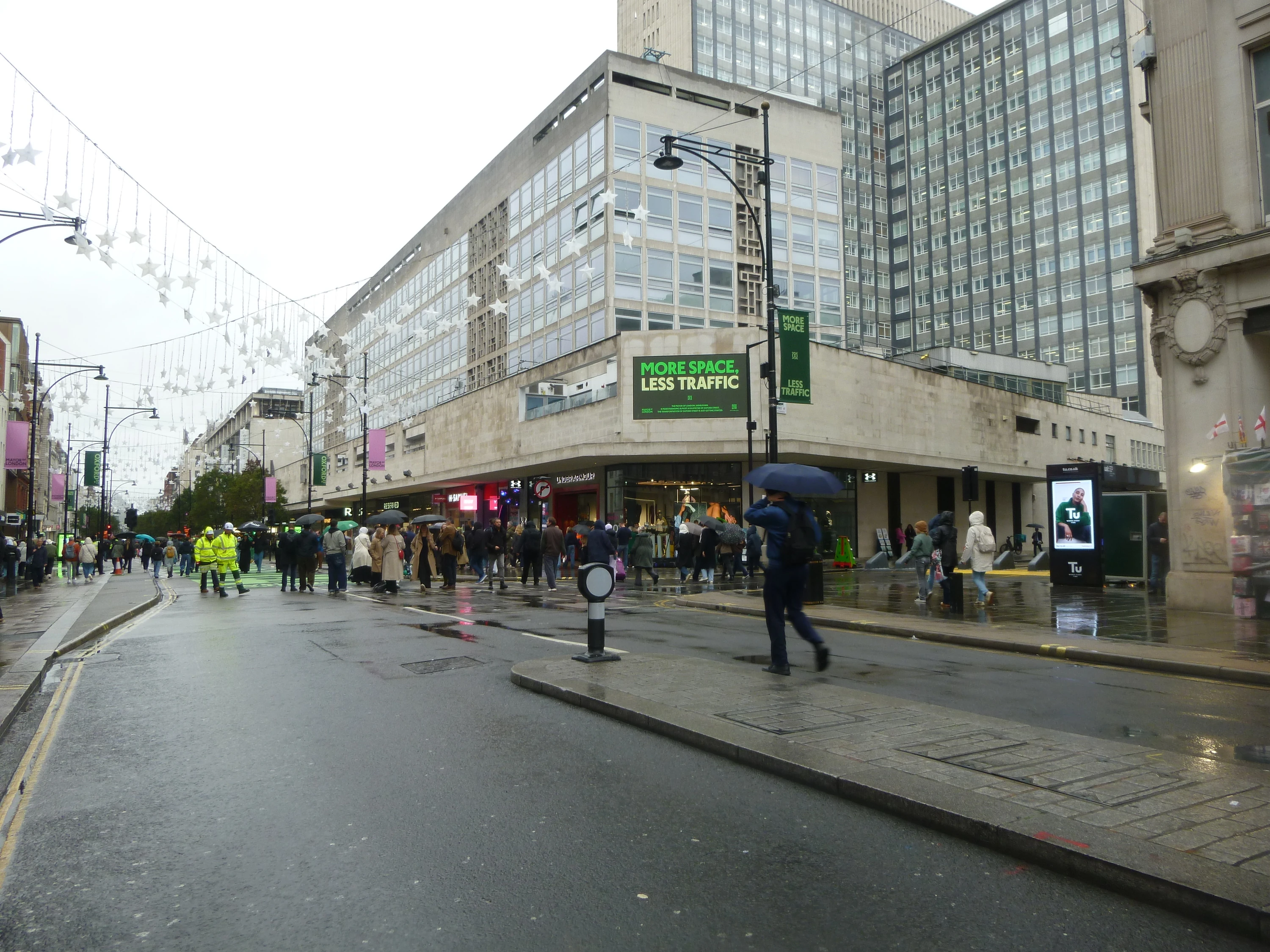
Strolling down the middle of Oxford Street without dodging a single bus might take some getting used to. As of Monday (October 26), almost a kilometre of the street, from Orchard Street near Selfridges to Great Portland Street just east of Oxford Circus, is officially traffic-free.
The street has had a makeover to mark the occasion. Its new ‘For Everyone’ identity, created by global creative company Koto with the Oxford Street Development Corporation, is popping up all over the street from today.
The big idea is the word ‘for’, which now sits at the centre of the Oxford Street wordmark. It’s meant to show that the street serves all sorts of people and purposes, or in Koto’s words, ‘for shopping and stopping’. There’s new London Sans and London Serif typography mixing old and new, plus a green colour palette that nods to plans for a greener street with more room to walk, meet and hang out.
Koto founder and CEO James Greenfield said the challenge went beyond tackling traffic, asking instead what the country’s most famous shopping street should become. The studio built the identity around the street’s ability to keep changing, so it can evolve as Oxford Street goes through what he called perhaps the biggest transformation in its history.
What has changed on Oxford Street?
The traffic-free stretch is now closed to cars, buses, taxis, private hire vehicles, bikes, scooters and pedicabs, around the clock. Emergency services can still get through at any time, and delivery vehicles are allowed in between midnight and 7am. Cars can still cross Oxford Street at a handful of junctions, including Duke Street, New Bond Street and Regent Street.
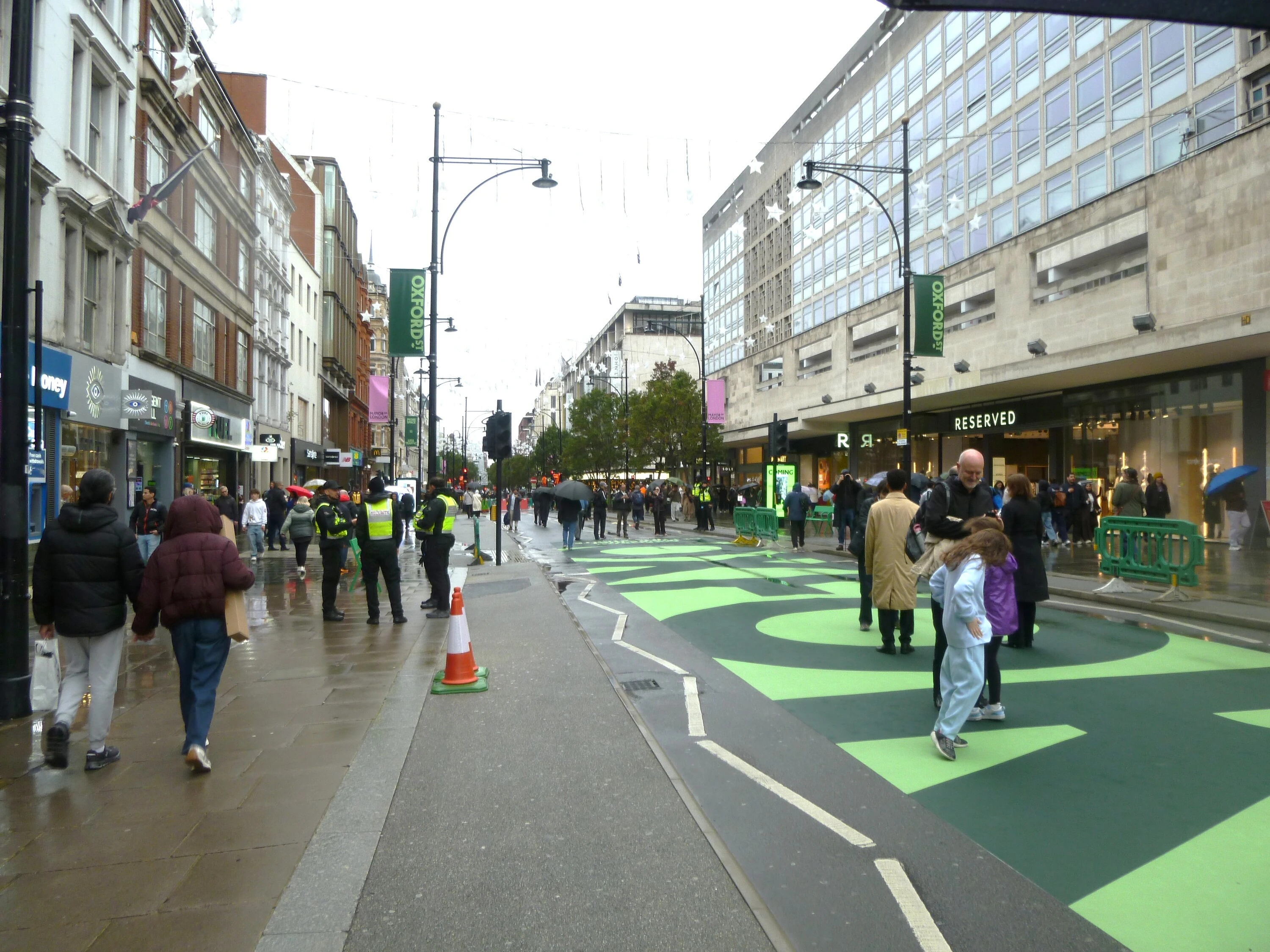
Don’t expect a total transformation just yet. For now, the street has temporary seating, planters, raised areas of road and security bollards. The bigger makeover with more permanent seating, planters and trees, isn’t due until next year once the Christmas rush is over and organisers have had a chance to see how people use the space.
If you usually get the bus, you’ll need to plan ahead. Routes including the 7, 94, 98, 139 and 390, plus night buses N7, N98, N113, N137 and N207, no longer run along this stretch. Most have been diverted onto Wigmore Street and Henrietta Place, a couple of minutes’ walk north, where new bus stops have been put in, and some routes now terminate early. Eastbound buses are following a temporary route via Wigmore Street and Regent Street for now. Cyclists have also been moved onto nearby streets like Wigmore Street, Henrietta Place and Margaret Street, but the tube is running as normal.
What are the reactions to Oxford Street’s pedestrianisation?
If the first day is anything to go by, people are making the most of it. When I headed down to Oxford Street, there were people doing full-on photo shoots in the middle of the road and children cartwheeling down it. Most people I spoke to were happy to share their thoughts, and the reaction was overwhelmingly positive, with one person telling me it felt good to see people being prioritised in London again.
‘It’s a travesty that society has given way to the car instead of the person,’ said Karen, who was visiting the street. ‘This is a good step in the right direction.’
Mayor of London Sadiq Khan, who has championed the scheme for years, marked the occasion as a ‘momentous’ new era for the street, and London’s transport commissioner Andy Lord said it would create a safer space for people to enjoy the shops. Dee Corsi, chief executive of the New West End Company, which represents hundreds of businesses in the area, called it a major opportunity to transform the visitor experience and bring more people to the West End.
It’s not just the people on the street that day, either. Around two-thirds of people who answered the question in TfL’s consultation backed the idea. But not everyone is convinced. The London Taxi Drivers’ Association has warned that restricting taxi access could isolate older and disabled passengers, and some locals have raised concerns about traffic being pushed onto surrounding streets.
This is only the first phase, and the traffic-free period is partly a chance to test how the street works and gather feedback. For now, it’s just in time for the Christmas rush, with more than 300 shops to explore without a bus in sight.
Get the latest and greatest from the Big Smoke – from news and reviews to events and trends. Just follow our Time Out London WhatsApp channel.
Stay in the loop: sign up to our free Time Out London newsletter for the best of the city, straight to your inbox.